

Urgent Support and Housing Needed for 70-year-old with Chronic Kidney Disease Forced into a Tent by a State Mandated Smart Meter

A GiveSendGo account has been set up for 70-year-old Bucks County resident Liza Regina Mousios, who endures the increasingly cold nights outside in a tent because of an unjust government mandate. She suffers from chronic kidney infections and an extremely severe, disabling condition recognized by the US Access Board and the Americans with Disabilities Act. About 1.5% of the population has severe electromagnetic sensitivity (EMS).
PA Act 129 mandates the use of smart meters, and because of the severity of her disability, Liza has been without safe, stable housing since the utilities implemented this mandate in 2019. She has lived in poorly maintained structures that lacked safe water or heat. When she had heat, she was able to work, which she enjoys, even though she is past retirement age.
The link to donate can be found here. Please contact Pennsylvanians for Safe Technology if you can help in any way, including a long-term goal to establish a safe house for people such as Liza. The address to contact is pasafetech@gmail.com. Details about Liza’s work as an acclaimed composer was covered in a previous article.
Liza lived happily in her home in Revere, PA, for 15 years prior to the implementation of Act 129, which mandates “smart electric meters” for every home and business in Pennsylvania. There are no exceptions to this heartless mandate, even for those who became severely ill upon their installation or even for those whose physicians report they are at risk of sudden death from the meters. There is no safe housing in PA for EMS sufferers unless one chooses to live without electricity or can afford private solar energy (not connected to the public grid) and special electronic filters to clean the power, so it is safe for someone who has this disability. This typically costs well over $100,000.
Smart meters operate using radio frequency and microwave radiation to communicate usage by the minute and have a poorly engineered switch-mode power supply that creates what is known as conducted emissions, commonly referred to as “dirty electricity” on the household wiring. Because of the cheaply made foreign components new smart meters commonly fail in the first few months after installations and must be replaced. Earlier versions were linked to fires but these have since been addressed by utilities. However, over-billing has be a frequent complaint since the smart meter change over.
Prior to the implementation of the mandate, Liza had mild, manageable EMS that made it difficult to use electronic devices like cellphones. This was severely exacerbated when a smart meter was installed on her neighbor’s home in 2019. She immediately developed excruciating headaches, tinnitus (ringing in the ears), difficulty thinking, nausea, and vomiting blood. She does not experience any of these problems when she is away from the meter, in the tent, or in housing that does not have a smart meter. Liza condition has advanced to where now she is barely able to use a cell phone or computer.
Compared to the general population, Liza and many people who have EMS cannot tolerate the radio frequency and microwave emissions due to the adverse health effects they experience. Early symptoms include difficulty sleeping, tinnitus, brain fog, and heart palpitations. Later, more serious problems can occur, such as blood pressure and blood sugar abnormalities, peripheral nerve problems, and other serious complications.
Unfortunately, there is no housing anywhere that we know of that has public electricity in Pennsylvania without a “smart” meter. People in multi unit buildings who live near the bank of meters are often the first to report health impacts.
Liza has been struggling in the cold since moving into the tent. People have been trying to help, but more is needed. A kindhearted friend bought her an air mattress and a bigger tent because her old one was wearing out. Others tried to help with donations of special electricity filters for the house and a special EMF cover for the neighbor’s smart meter. Those measures have taken the edge off the pain when she is in the house; however, she is still unable to sleep in the house. Now, the nights are growing longer and colder, and life in the tent is already impacting her health. She now has blood in her urine and continues to vomit blood when she sleeps in the house. She is so cold that she is using a space heater to heat her tent. She keeps a knife to cut her way out of the tent if it catches fire.
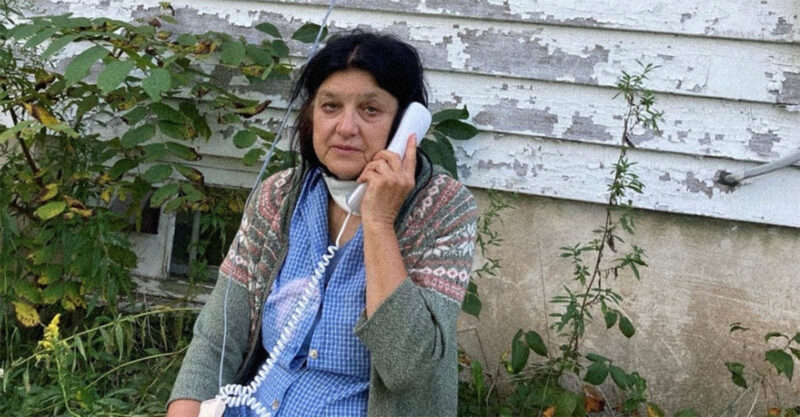
Liza using a wired landline to talk to her doctor. Fortunately, if the weather is mild, she can sit outside and use a corded landline strung through the house window.
Liza is not alone. About the same time she returned to live in her tent, a 60-year-old woman in the Squirrel Hill area of Pittsburgh also demonstrated similar problems. “Carol”, who does not want her real name used, is in her 60s and was an early adopter of wireless technology. She reported using four laptops at a time in her younger days. She is now barely able to use a computer due to EMS. Her condition and level of function declined so sharply this summer that someone from an online support group contacted an advocate’s office and requested immediate help for her.
Carol was found in her basement with severe chest pain, barely able to speak or walk. She begged for help to get out of her home, in an area with a great deal of wireless infrastructure. She needed complete assistance to leave her home and could barely speak, had difficulty breathing, and could not eat or care for herself. A half hour away from her home, she began to regain her strength and energy and noted she could breathe well again. She spent the night in a camper on an advocate’s family property, and by nightfall she was able to go outside by herself. The next day, she recovered and was easily walking around outside by herself.
Others are also suffering throughout the state. One woman, like Liza, suffered immediate serious complications from EMS, but except for the first two months, she has been able to live in her home. Extensive remediation costing well over $25,000 was needed to block the radiation. Today “Theresa”, a Berks County resident who also does not want to use her real name, is no longer able to work and is limited in where she can go. Despite a letter from a medical school professor who is a subject matter expert, citing the risk of arrhythmias and sudden death, her utility refuses to accommodate her disability. This flawed law allows for no further recourse.
There are many others; most, but not all, are women. Most are well educated and could be working, but they cannot now because of their disability and the increasing proliferation of wireless radiation. “Theresa” is fortunate to be able to leave the house. Many cannot. Some examples:
• “Susan, who lives in Southwest PA, leaves her house only for a hairdresser appointment once a month, for an early morning Monday appointment when no one else is there (and no cellphones). Her husband must do all the shopping. She, like many, no longer can see a doctor at a physician’s office.
• Doreen, in northeast Pennsylvania, is severely physically disabled and has great difficulty finding a home health aide who is willing to work without bringing a cell phone into her home.
McKenzie is a young man with autism in Southwest PA whose seizures and difficult behaviors have increased over the years of living near smart meters and an increasing number of cell towers. His family struggles to afford shielding and other mitigation measures that help.
Most families struggle with the staggering costs associated with a diagnosis of EMS, as well as the resultant inability to work and loss of income. Remediating to mitigate the effects is extremely expensive and well out of the reach of most people. A shirt to help block the radiation from affecting the heart or brain typically costs $150; a simple cap costs $50. Most people would not consider shielded clothing “attractive”. EMS is completely preventable through the use of wired technology, making it an especially heartbreaking diagnosis.
Wireless infrastructure, whether it is a smart meter, a cell tower, or a small wireless facility, all transmit radio frequency and microwave radiation, which have been shown in research to adversely affect health. Over 10,000 pages of research documenting this were filed by attorneys in Environmental Health Trust et al. v. FCC. The court ruled in August 2021 that the FCC failed to provide evidence to the court to support the FCC guidelines, and they refused to answer the court’s questions about extended exposure, harm to children, and those already harmed. The court remanded the matter back to the FCC; however, no action has occurred. Attorneys for EHT and CHD are having to return to court to reinforce the judges orders.
The women who have EMS and are doing well either spent well over $100,000 on mitigation or moved to another state where ‘smart meters” are not mandatory.
Information presented at the EMF Medical Conference notes that up to a third of the population is developing this condition but does not yet determined the cause.
Pennsylvania utilities must stop this heartless insistence on using “smart meters,” especially when it is adversely affecting the health of the consumer. They must recognize and accommodate this disability and work to employ safer billing methods that do not injure or disable their customers. Most states do. Perhaps minute-by-minute electrical usage data is not valuable enough to offset the serious health injuries to so many. These utilities only look at the benefit to them, not the cost to their customers.
Twenty years ago, most suffers of celiac disease did not understand the need for gluten-free bread; today, most people do. The problem of EMS may be new to most people, even to physicians who have not studied it; however, with a third of the population on its way to developing EMS, there is an urgent need for awareness, education, and solutions.
The telecom industry is spending heavily (over $100 million in 2022) trying to obfuscate this health issue in our state legislatures much like similar efforts seen in the past by the tabacco industry. Lawmakers must offer Pennsylvanians a choice when it comes to elemental protection against harm and repeal PA Act 129 & 50 and put into place protections for all customers. PA must come into conformity with its neighboring states and give its residents their lawful choice to opt-out of these dangerous meters.